Artificial Intelligence
Article
Learning in the Age of AI: Pedagogy, Transmission, and Digital Creation
By Shirin Abu Shaqra, PhD candidate in digital creativity and augmented museography at École NAD-UQAC, filmmaker and XR developer
2026-03-24
By Shirin Abu Shaqra, PhD candidate in digital creativity and augmented museography at École NAD-UQAC, filmmaker and XR developer
2026-03-24
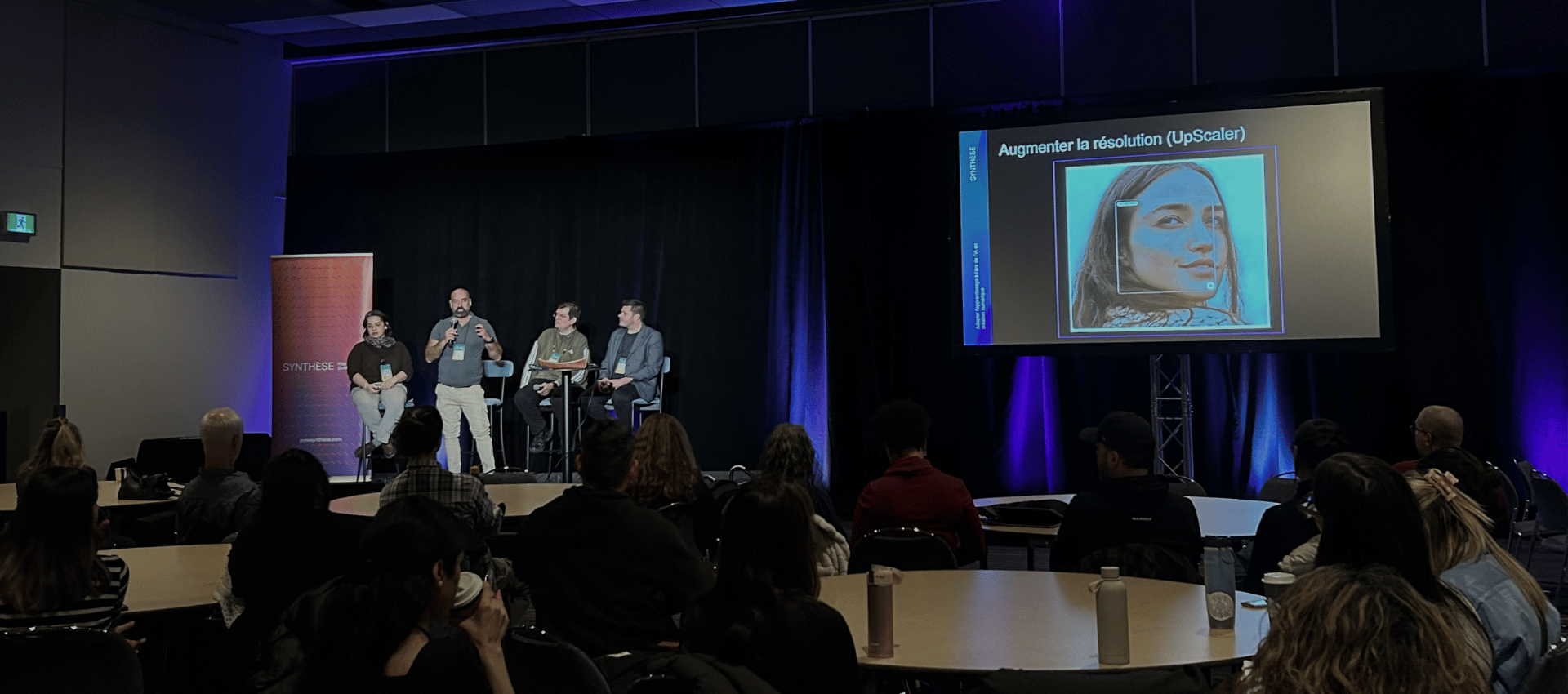
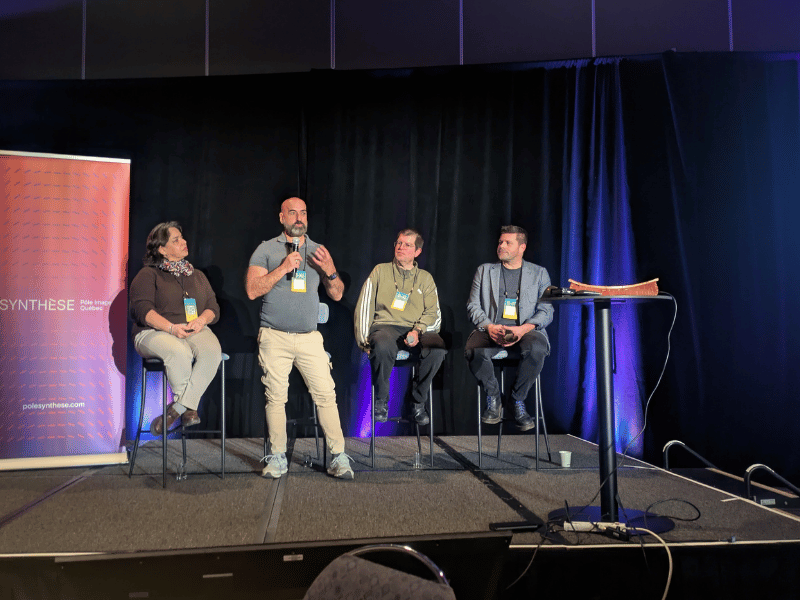
E-AI 2026 launched its second edition on February 18 and 19, with SYNTHÈSE participating once again, this time with a panel entitled “Adapter l'apprentissage à l'ère de l'intelligence artificielle (IA) en création numérique”
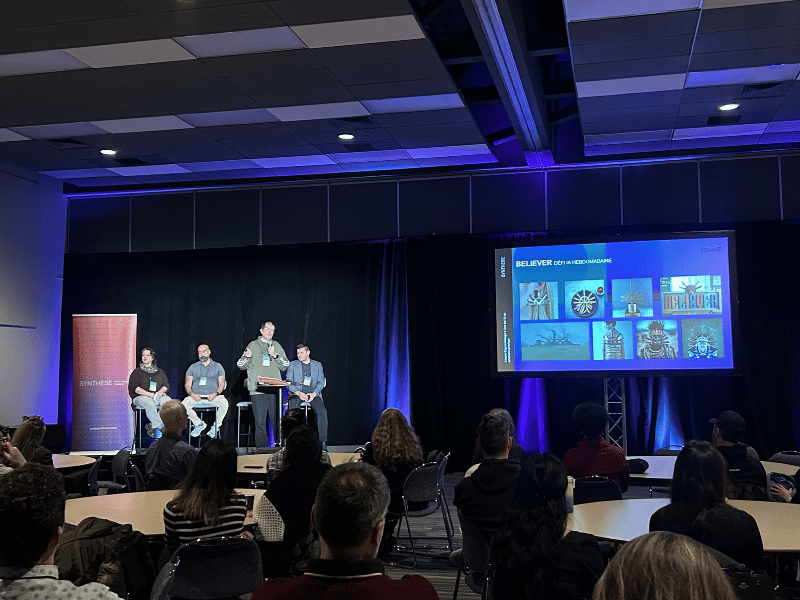
Three educators and practitioners with distinct trajectories presented the aspects of their work that integrate AI. Robin Tremblay, co-founder and instructor at the NAD Centre in 1991—now École NAD-UQAC—has been teaching 3D creation for thirty-five years. He has worked in post-production at studios such as Rodeo-FX and Groupe Image Buzz. Julien Bouvrais, co-founder of the new startup PragmaFrame, which offers strategic consulting in innovative technology, has spent more than twenty-five years in the video game industry, notably as Vice President of Research and Development at Believer, a California-based studio, and as Director of Technology at Eidos Montréal. Stéphane Nepton, an Innu artist and educator currently in a research-creation master’s program at École NAD-UQAC, is also a digital cultural mediator for First Nations at Printemps Numérique. Three different teaching and professional contexts, one shared stance toward the tool: the question is not whether to integrate generative AI into creative practices, but how, and for whom.
The digital creation industry is undergoing a period of accelerated transformation. Tools evolve faster than curricula. The fear that AI will render skills obsolete is real, and training struggles to keep pace with the rapid evolution. In this context, the role of educators and corporate trainers becomes essential: they are the bridge between technology and creators.
Resistance to AI in creative and educational environments is palpable. Robin Tremblay’s 3D students hesitate to integrate it, fearing they will lose their artistic integrity to a machine that might make decisions for them. His pedagogical response is to show them that AI is already present in the software. It is discreetly integrated into the tools they have been using for years. The denoiser in Houdini, image upscaling (improving image resolution), and generative fill in Photoshop are all functions based on machine learning that no one had yet identified as such. Showing these familiar uses reduces students’ perceived threat and opens a more productive conversation about what AI can or cannot do.
Julien Bouvrais, with twenty-five years in the video game industry, observes the same resistance within corporate teams. Believer was a studio centered on massive AI integration. Despite its brief two-year existence, Bouvrais and his team created experimentation spaces detached from production, laying solid foundations. Fun weekly challenges such as generating an image with a diffusion model, exploring audio generation, experimenting with video, allowed teams to get comfortable with the tools without the pressure of deliverables. He even created AI-generated podcasts based on updates from their Notion and GitHub applications. This made the technology useful, accessible, and rooted in the daily life of the studio. Learning through play, without immediate production stakes, proved more effective than any formal training.
What emerged from the testimonies is that AI handles tasks humans take little pleasure in—time-consuming, repetitive, and technically heavy tasks. Robin Tremblay gives the example of a student project where scoops of ice cream had to be modeled in 3D. An organic object that melts in the open air cannot be photogrammetrized (a model created from real photos). Selecting good photographs online and processing them through Hugging Face, a free and accessible tool, enabled the generation of basic geometries in a few minutes. This freed students to focus on ideation, design, and visual storytelling. Two years ago, two out of twelve teams used AI in their projects. This year, the majority did. The result, for students and according to the jury as well, is better.
Julien Bouvrais expresses the same principle differently. For him, it is not about learning the tools as much as understanding what one wants to do with them. If we have a vision of the architecture we need, with critical thinking and creative vision, AI multiplies our capabilities. Coding and repetitive tasks can be delegated to the machine. Tools will change. The capacity to think will not. Bouvrais also raises issues the industry often avoids naming: Which models should be used, at what cost, and under what legal conditions? Large commercial models are powerful but expensive. Open-weight (1) models are accessible but require complex interfaces like ComfyUI to be fully utilized (2). And frequent commercial API updates can render months of integration work obsolete. Navigating these constraints is now part of the job. His solution: build custom tools tailored to the real needs of teams rather than forcing the adoption of generic tools. At Believer, this meant developing an internal chatbot and a dynamic AI-generated wiki capable of answering project-specific questions in real time.
Beyond tools and methods, the three speakers converge on a fundamental idea: AI is only as valuable as the transmission that accompanies it. The goal is to train creators who understand systems, not users who depend on tools.
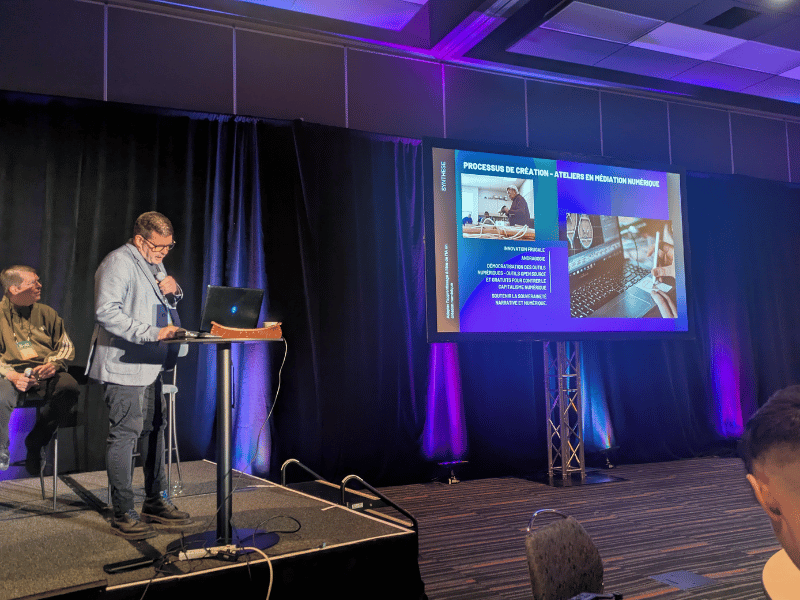
Stéphane Nepton, an enactive art practitioner (learning centered on interaction between the individual and their environment) from the community of Mashteuiatsh at Lac St-Jean, has spent twenty years fostering intergenerational transmission of Indigenous knowledge through digital arts. For him, cultural health depends on language, connection to the land, and narrative sovereignty. In First Nations communities, which have survived the physical and cultural genocide of colonial policies, this concept integrates the physical, mental, emotional, and spiritual as inseparable conditions of collective well-being. For too long, Indigenous peoples have been portrayed by non-Indigenous creators and through colonial archives. Digitized tangible and intangible heritage, and AI in particular, now offer means for reclamation, resistance, and reconnection within the community.
Practically, using archival photographs, Stéphane develops an accessible creation pipeline: upscaling a low-resolution historical image, generating multiple angles with Qwen AI, converting it into a 3D model using Apple’s ML Sharp model, cleaning the 3D model, animating it with a virtual camera, then animating it with Gaussian Splatting. He teaches Elders to appropriate these tools so that they, in turn, transmit their knowledge to youth, who in turn extend the cycle by helping Elders with digital tools. Learning therefore becomes circular. Nepton is currently developing a workshop called Tipatshimun, an Innu word meaning “the one who tells a story,” centered on genealogical and identity reclamation through digitized family archives. Digital technology becomes a pretext for intergenerational transmission and an attractive factor for youth—not an end in itself. He gives an example: the handcrafted making of a traditional Atikamekw canoe taught by Mr. Benoît Ottawa, documented and digitized through photogrammetry to create a 3D model. This canoe then becomes a navigable object in a video game environment set in the boreal forest. Digital technology does not replace the ancestral gesture. It extends it and transports it into a space where youth can reclaim it in their own language.
What these three educators do within their own spheres illustrates something larger. Their tools are free, their knowledge shared, their projects often without a defined commercial model. In a capitalist system that measures value through economic and monetary transactions, all this remains invisible. Yet the value is real: a preserved culture, a trained generation, a reduced divide.
This accessibility raises a broader question: if real value is not measured through transactions, how should it be evaluated? In his book The Last Economy (2025) (3) , Emad Mostaque poses the problem. The economic model inherited from Adam Smith, which measures a nation's health through its GDP, has become obsolete. Mostaque illustrates the absurdity of the system: a divorce or cancer contributes positively to GDP by multiplying expenses (4) but does not maximize happiness or health.
Mostaque goes further. When an AI tutor offers personalized, free education to every child on Earth, the education sector will collapse on dashboards, and we will try to save it. Nicolas Negroponte attempted a universal education project in the 2000s with One Laptop Per Child, which—despite implementation challenges—enriched the conversation on technological accessibility. Wikipedia bankrupted Britannica while offering twenty billion pages of free knowledge. Its contribution to GDP is negative. Its contribution to humanity is immense. With all its imperfections, it remains a transformative tool, provided one retains critical thinking.
This paradigm shift is already being lived by the digital creation industry. The value of what Robin Tremblay, Julien Bouvrais, and Stéphane Nepton do is not measured in generated revenue. It is measured in transmitted cultures, lowered barriers, and creators trained to think rather than consume. This is what Mostaque calls purposeful AI, deliberate AI with a defined purpose.
To learn more, a recording of this panel is available online on the EXPERTS continuing education platform.
--
(1) Open‑weight models are models whose parameters are public and downloadable. They allow developers to use them but not to modify them, unlike open‑source models, which allow code modification.
(2) For a more accessible alternative to open‑weight models, Leonardo offers an intuitive interface for generating images and videos.
(3) Mostaque, E. (2025). The Last Economy. Intelligent Internet. Retrieved from https://ii.inc/web/the-last-economy
(4) Ibid., p. 35


