RD & Innovation
Training
News
Six conferences available for replay: Acting on our AI skills (2025)
By Lili Trottier
2025-02-19
By Lili Trottier
2025-02-19
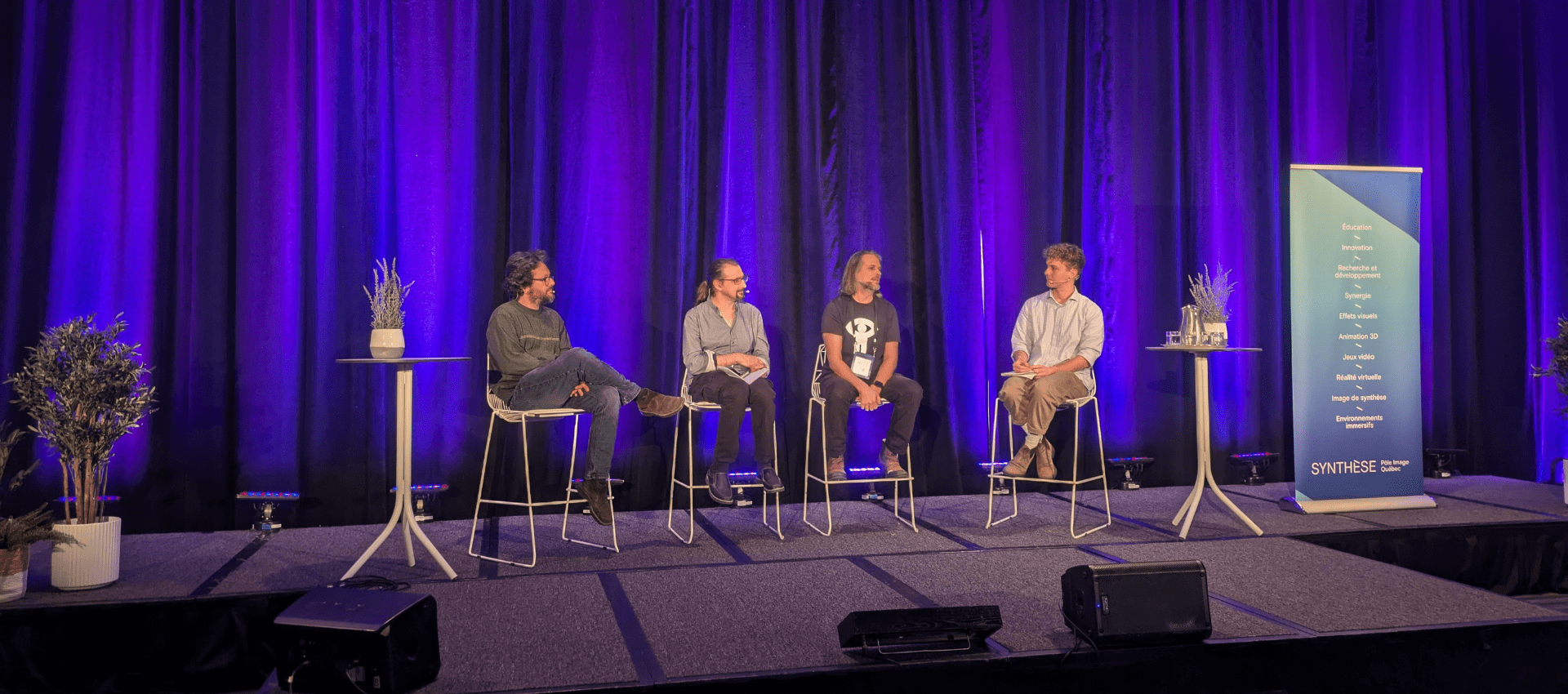
These two mornings, organized by SYNTHÈSE, were an opportunity for professionals and students in the digital creation sector—animation, visual effects, video games, and immersive experiences—to explore the impacts and opportunities that artificial intelligence (AI) offers to the cultural, creative, and entertainment industries.
The program brought together experts from the field who highlighted emerging technologies, concrete case studies, and in-depth reflections on how to better integrate AI into professional and artistic practices.
Our experts will examine these questions to validate the ethical practices of the various options available. This conference will highlight the range of software available on the market, including the specific features of each program and their advantages in the digital creation sector. A map of AI uses in creative technology will be presented and explained.

Chief Technical Officer and Production Technologies, National Film Board of Canada (NFB)
To efficiently create extensive 3D worlds, Pixar invented this open-source ecosystem, which has now become a staple in the digital creation industry. Most 3D software companies now integrate these features to make collaboration between artists more fluid and efficient.
Experts will present the uses of USD principles for companies in the video game, visual effects, animation, and immersive experiences industries, as well as real-life examples of implementing new working methods to promote collaboration between the various creators of a digital product.
This presentation will discuss the evolution of NeRF techniques, which involve creating high-quality, instant 3D environments from photographs. This powerful and rapidly evolving technology is significantly changing the way realistic images and videos are produced, opening up new possibilities for creating immersive virtual reality experiences.
NeRFS technologies could have a major impact on CGI techniques and leave photogrammetry a step behind. The evolution of this technology is worth following.

Full Professor in the Department of Electrical Engineering and Computer Engineering, Laval University, and Deputy Scientific Director, Institute for Intelligence and Data (IID)
Today, more and more documentaries and films are being made with AI-generated content. Sometimes, none of the content in the films consists of real footage or authentic archives. So, how can we develop ethical working methods that give rise to new ways of filmmaking with AI tools, without falling into misinformation?
This presentation offers some working ideas to help us understand the pitfalls and address the issues associated with archival-type generative practices.

Postdoctoral researcher, Research Chair in Francophone Artificial Intelligence and Digital Technology (INRS)
Structured data is the basic building block for creating a proprietary AI tool. This data is collected and formatted in a specific way. It is then compiled into a digital database system that can be called upon to provide references to the AI tool.
The idea is to understand how to set up such a project. Who are the players involved in this project, and how can museums, libraries, or even artist collectives undertake an initiative of this kind?

Data Governance Manager, Experience and Transformation Division, Bibliothèque et Archives nationales du Québec (BAnQ)

Visitor Experience Strategy Coordinator, Musée national des beaux-arts du Québec (MNBAQ)

PhD candidate – Culture, Datafication, and Digital Technologies, National Institute for Scientific Research (INRS) – UCS Center
In the field of digital creativity, spectacular automated oversized projections, large-scale entertainment productions, and musical performances by international celebrities provide Quebec talent with significant opportunities to shine.
This presentation will explore the technical and technological aspects of these large-scale projects and their ability to establish faster and more efficient production sequences than five years ago, thanks to the contribution of machine learning technologies, concepts, and ideation. The idea is to understand the possibilities that AI already offers and those that could be beneficial for immersive show production pipelines.
This project is made possible thanks to our partners: E-AI, Palais des congrès de Montréal, Université du Québec, and collaborators: Bureau du cinéma et de la télévision du Québec (BCTQ), Centre de développement et de recherche en intelligence numérique (CDRIN), Compétence Culture, La Guilde du jeu vidéo du Québec, National Film Board of Canada (NFB), and Xn Québec.