News
Continuous training
Visual effects and animation
Video games
Houdini 20.0 Tutorial: Mastering Vellum Simulation
By Lili Trottier
2025-08-13
By Lili Trottier
2025-08-13
Why Vellum is a must-have for simulation
SOP vs DOP: choosing the right approach
Understanding Cloth and String constraints
Going further: soft bodies, balloons, plasticity…
Houdini’s Vellum has radically simplified the simulation of cloth, ropes, hair, and fluids, while offering exceptional artistic control.
This article provides an overview of SOP and DOP approaches (we promise to keep it short!) and explores how to master the simulation of fabrics, hair, and skin, optimize simulations in complex scenes, and develop efficient workflows for integrating them into visual effects and animation projects.
This overview is intended for those new to Vellum simulation, but already comfortable navigating Houdini and the Geometry context.
Of course, Vellum can’t be summed up in just a few lines… 🫠
Instead of condensing everything here, we recommend the ultimate Houdini 20.0 Vellum training, a free 9-hour online course made up of 29 modules, available in French or English, and exclusive to professionals and recent graduates in digital creation in Québec.
When working with Vellum in Houdini, one of the first decisions to make is whether to use SOPs (Surface Operators) or DOPs (Dynamic Operators).
SOPs are used for building and modifying geometry and volumes, while DOPs are dedicated to dynamic simulations. In other words, should you build your simulation directly within the Geometry context, or through the more traditional Dynamics context?
In short, the SOP approach is more direct and accessible, whereas DOPs allow for deeper customization.
A bit of background: Vellum is the latest major solver integrated into Houdini since version 17 (released in 2018). It’s based on a particle-based dynamics approach.
This means that a mesh (for example, a piece of cloth or a rope) is broken down into individual points, called particles. Each particle is simulated independently, but constraints are added between them to reproduce realistic physical behavior such as elasticity, stiffness, and flexibility.
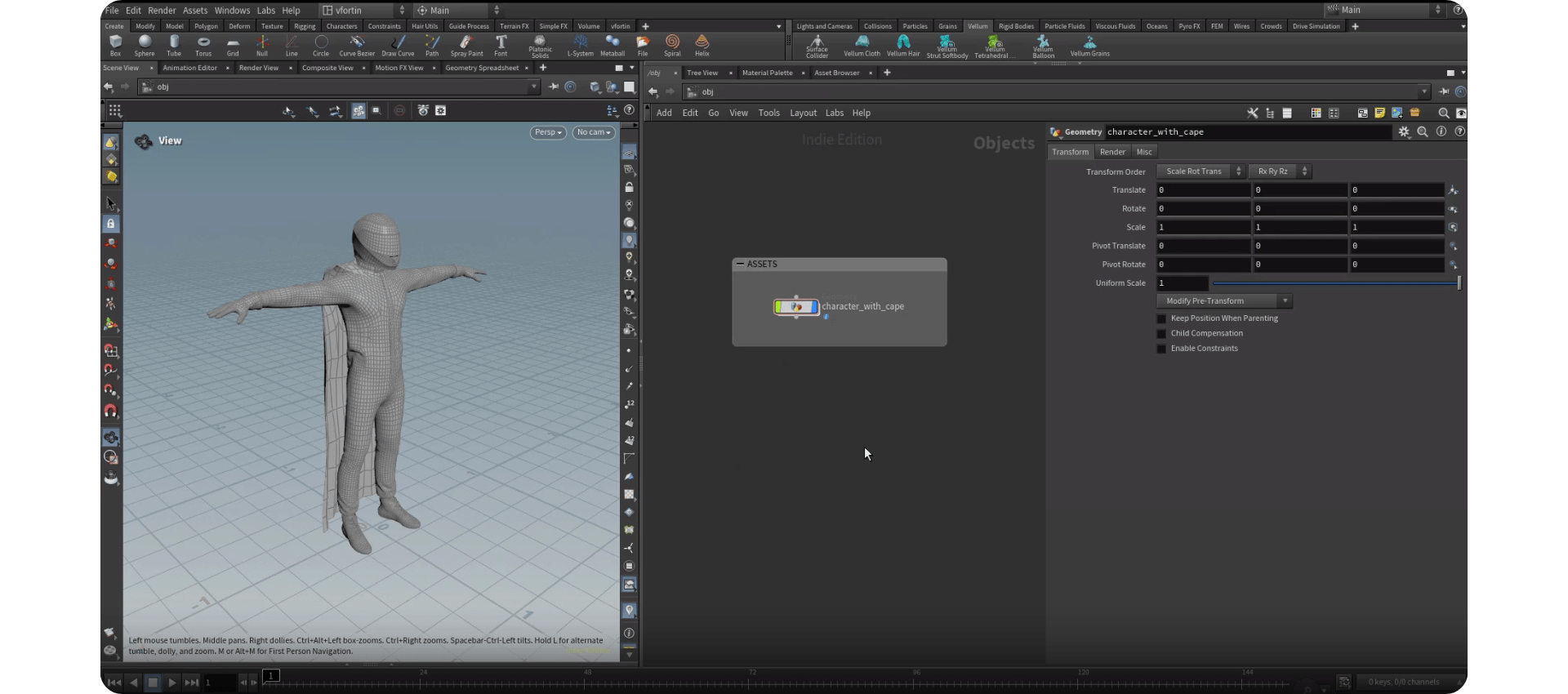 Exemple de la plateforme Houdini | Formation Houdini Vellum 20.0
Let's start with a little history. Vellum is the latest major solver integrated into Houdini since version 17 (released in 2018). It is based on a particle simulation approach called Particle-Based Dynamics.
In this system, a mesh (for example, cloth or rope) is broken down into individual points, called particles. Each particle is simulated independently, while constraints are added between them to reproduce realistic physical behavior such as elasticity, stiffness, and flexibility.
In short, Vellum isn’t just for clothing simulations — it can also be used for curves, soft bodies (like balloons), or even particle simulations for snow, sand, or liquid effects. It’s an efficient, flexible method, particularly well-optimized for GPU processing.
So why are there two methods (SOP and DOP)?
The reason is simple: Vellum was first introduced through the DOP context in Houdini 17, then later optimized with a more flexible, modular SOP version, making it easier to prototype and iterate.
This distinction is important — both approaches are fully valid and seamlessly integrated within Houdini.
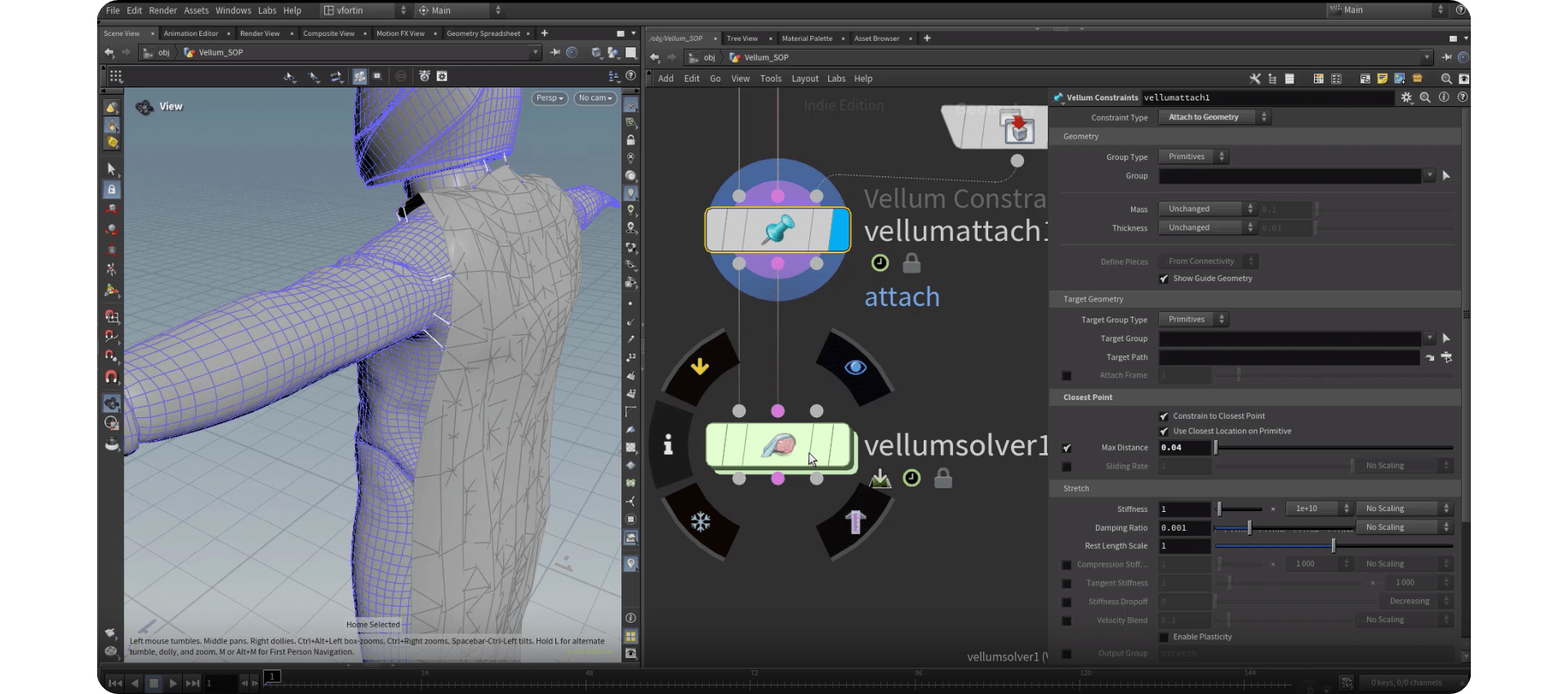 Exemple de la plateforme Houdini | Formation Houdini Vellum 20.0
The SOP context lets you build a Vellum simulation directly inside a Geometry node, without switching to the DOP context.
With just a few nodes — Vellum Constraints, Vellum Solver, and some quick adjustments — you can create a complete setup. It’s modular, visual, easy to organize, and fast to iterate on.
Even better, the presets are generous. For example, a single Vellum Configure Cloth node automatically prepares the right physical attributes, generates constraints, and sets key properties such as density, thickness, collisions, and gravity.
The solver itself includes handy built-in parameters (like timescale, substeps, constraint iterations, and visualization options) — all without the need to build a complex network.
For quick simulations, artistic tests, or single-geometry setups, the SOP method is often smoother and faster to work with.
The DOP context (Dynamic Operators), on the other hand, involves explicitly moving to a dedicated simulation network.
You need to export the geometry and constraints via Null nodes, import them into a DOP Network, and then add a Vellum Source, Vellum Object, and Vellum Solver, connecting them to collision objects or external forces.
It takes more time to set up, but it offers greater precision and flexibility, particularly in complex pipelines, distributed simulations, or cases where the simulation needs to be triggered, animated, or modified dynamically.
In summary, the SOP workflow is more direct and accessible, while DOP provides deeper customization.
For many projects, the SOP workflow is more than enough, especially when the goal is prototyping, experimenting, or working solo on a specific effect. It allows you to move faster while maintaining control.
However, once simulations become more demanding, need to interact with other solvers, or must fit into a rigorous pipeline with dynamic adjustments, DOP becomes the better choice.
The best part? You don’t have to choose — both methods are compatible, and what you learn in SOP can be applied directly to DOP-based projects.
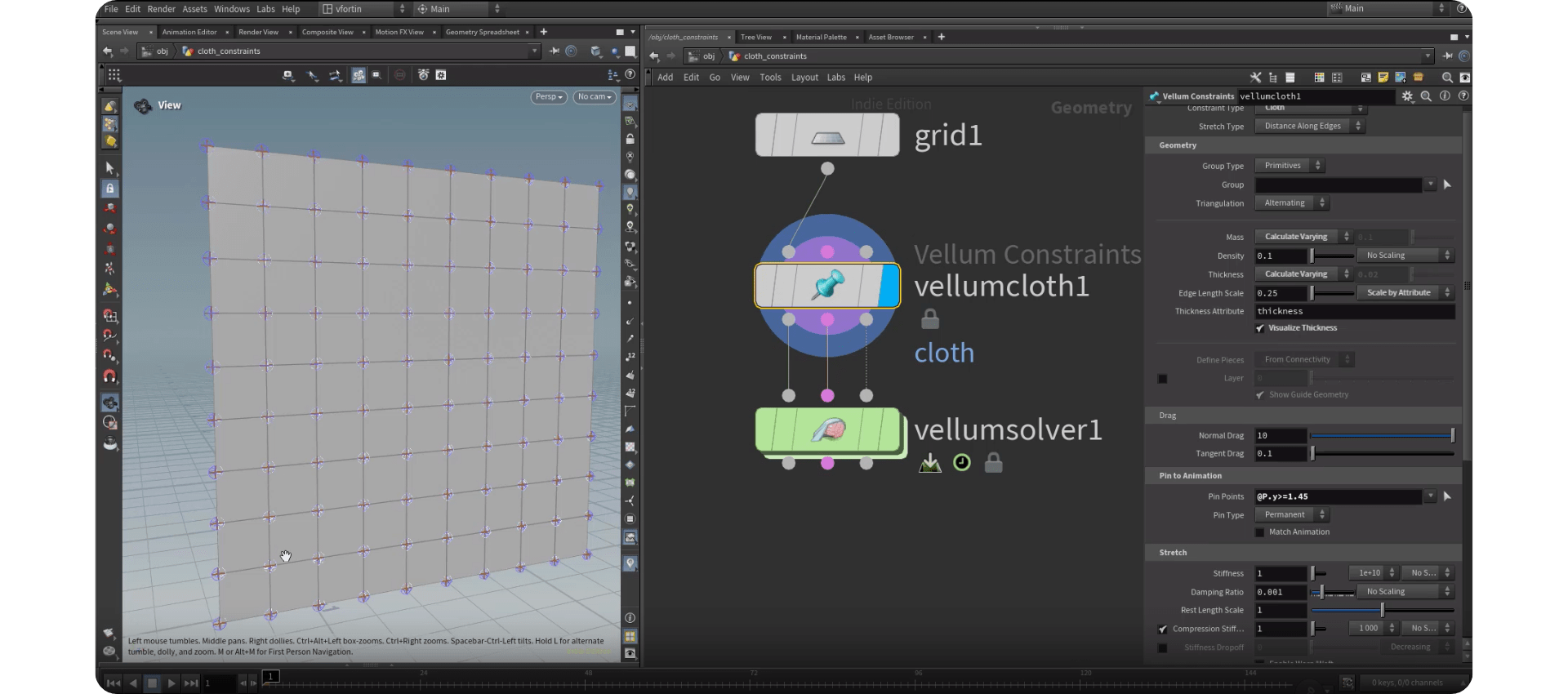 Exemple de la plateforme Houdini | Formation Houdini Vellum 20.0
Vellum relies on physical constraints to simulate the behavior of soft or flexible objects. Two main types of constraints are most commonly used:
Cloth, for surfaces (e.g., fabrics, skin)
Strings, for lines (e.g., ropes, hair)
Each point in the geometry is connected to others by “links” that limit its stretch and bend capabilities. You can also add weight, friction, or air resistance (drag) to fine-tune realism.
In the Houdini 20.0 Vellum training, you’ll explore how these constraints affect simulations, how to tweak them effectively, and—most importantly—how to avoid common pitfalls like the dreaded fabric that collapses in on itself 🫠 or a rope that stretches way too far.
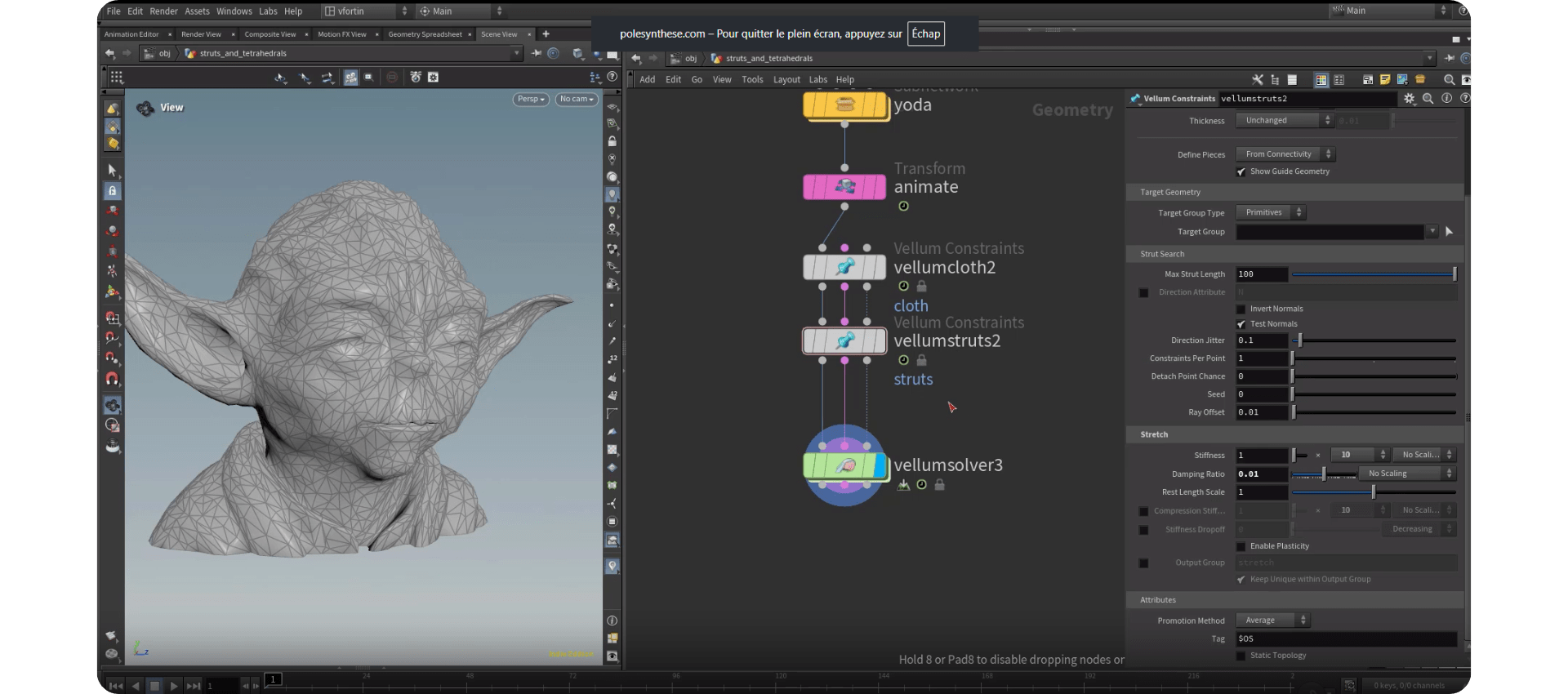 Exemple de la plateforme Houdini | Formation Houdini Vellum 20.0
Not too much of a headache yet? 😅 If you’re starting to feel eye strain, that’s normal. Houdini’s Vellum simulation is dense, and nothing beats a step-by-step demo.
The full (and free!) online course, led by expert Vincent Fortin in collaboration with École NAD-UQAC, runs 9 hours and includes 29 modules.
SOP vs DOP
Cloth and String constraints
Attachment constraints
Soft bodies
Balloons
Plasticity
Detachment – Attach to geometry
Detachment – Pin to animation
Detachment – Weld
The Houdini 20.0 Vellum course is free and exclusive to professionals working in a Québec studio that is a member of one of our three partner associations: La Guilde du jeu vidéo du Québec, BCTQ, and Xn Québec.
The training is also available to recent graduates of a digital creation program from a public institution in Québec. You have up to one year after graduation to take EXPERTS courses.
Recent graduates can contact experts@polesynthese.com to activate their account.
Vincent Fortin is a freelance technical artist specializing in Houdini, and an expert in FX and procedural creation for film, video games, augmented/virtual reality, and live events.
He has worked on major titles such as Assassin’s Creed, Far Cry, Deus Ex: Mankind Divided, and Shadow of the Tomb Raider.
A renowned instructor, he collaborates with world-class studios — including MPC, Framestore, RodeoFX, Ubisoft, EA, and WB Games — helping them optimize their pipelines. He also teaches at École NAD-UQAC and Collège O’Sullivan, where he trains the next generation of digital artists.